


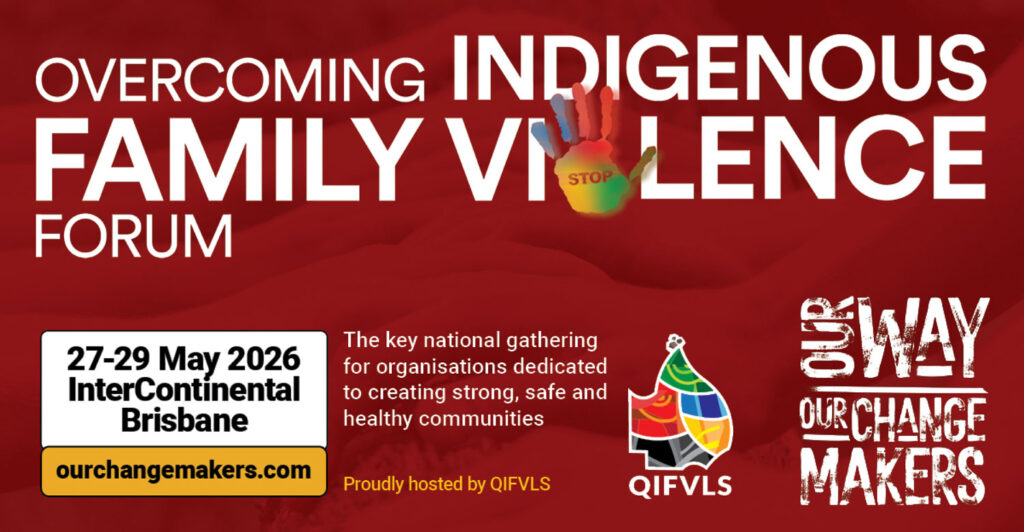
This year’s Overcoming Indigenous Family Violence was held in Brisbane over the 27th and 28th May, with a cultural workshop at Musgrave Park on the 29th.
Once again, the Forum became a focal point for Aboriginal and Torres Strait Islander community members, Aboriginal Community Controlled Organisations, and representatives from a range of related sector organisations to come together to learn, share knowledge and engage in meaningful discussion.
The 2026 Forum was held at the InterContinental Brisbane, with delegates and speakers travelling from across Australia and the Pacific Islands to attend.
This year’s event was themed “Our Way, Our Changemakers” in recognition of the powerful work being driven by Aboriginal and Torres Strait Islander organisations to address domestic, family and sexual violence – their diverse voices connected by a shared passion and a commitment for change.
Day One
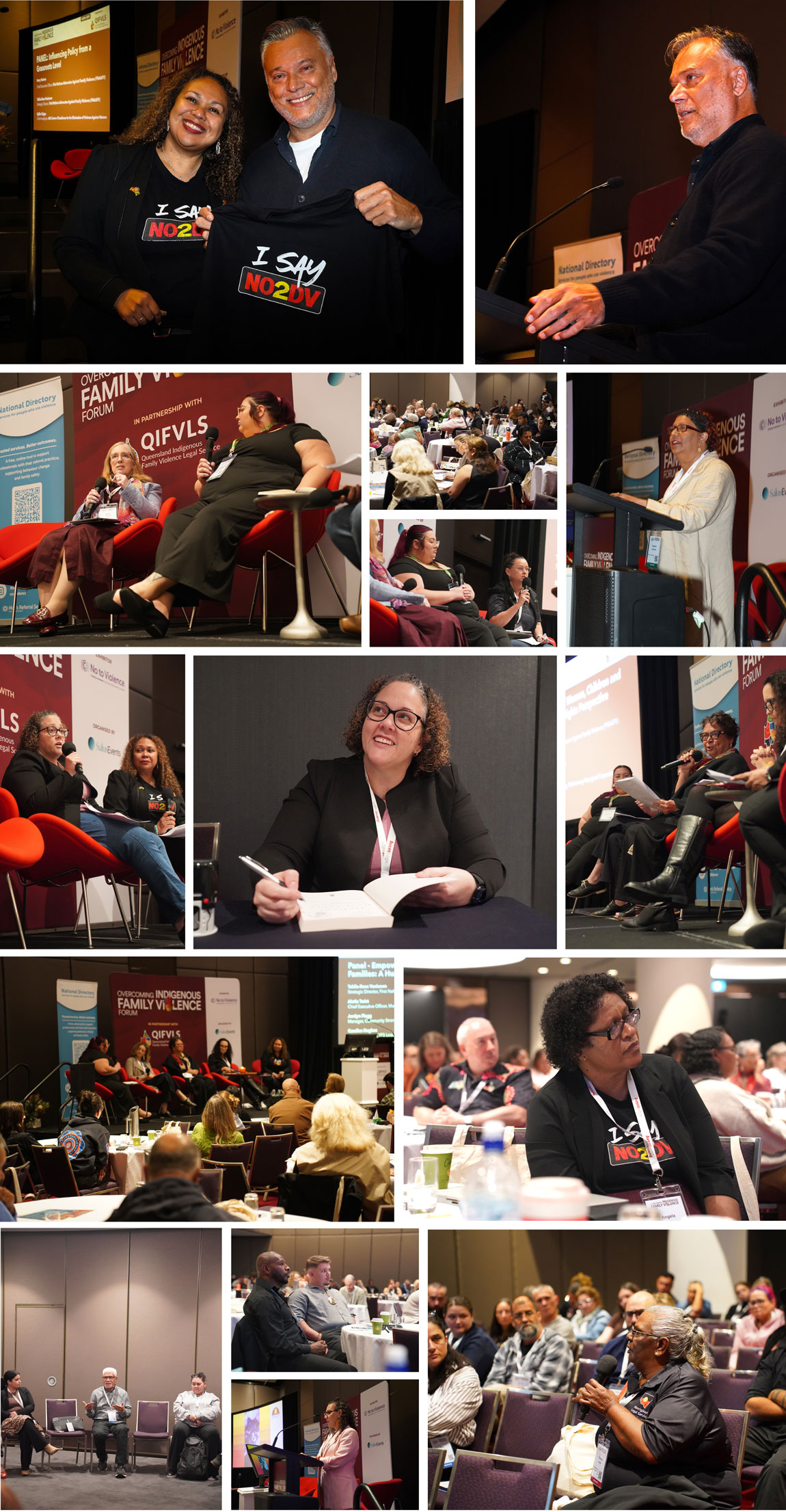
QIFVLS’ Acting Chief Executive Officer Thelma Schwartz, chairing the Forum for another year, launched the conference with opening remarks that set the tone for the next two days and introduced the keynote speaker, Stan Grant.
Stan Grant, a Wiradjuri, Kamilaroi and Dharwal man, is a celebrated journalist, author and media presenter who has spoken out on Aboriginal and Torres Strait Islander issues for 40 years. Stan delivered his Forum address on forging a path of justice and unity for our Country.
Day one featured a series of panel discussions and speakers delivering thought provoking conversations around the theme of ‘Changemakers in Action’. This included discussions about ‘Influencing policy from a grass roots level’ and ‘Empowering women, children and families: a human rights perspective’.
The QIFVLS team were proud to hear our Board member, Dr Marlene Longbottom, launch her book: ‘Defiant Resistance: Shattering the silence on violence against Indigenous women’.
Yarning Circles over both days provided delegates with an opportunity to personally connect over a range of topics. Also, in a first for the Forum, breakout steams were introduced offering delegates the chance to engage with specialised areas of interest.
The theme of System Reform also featured on day one, with QIFVLS Board member Christine Thomas partnering with QATSICPP Deputy CEO Muray Benton to deliver a presentation named ‘From Punitive Pathways to Healing Journeys’.
Day Two
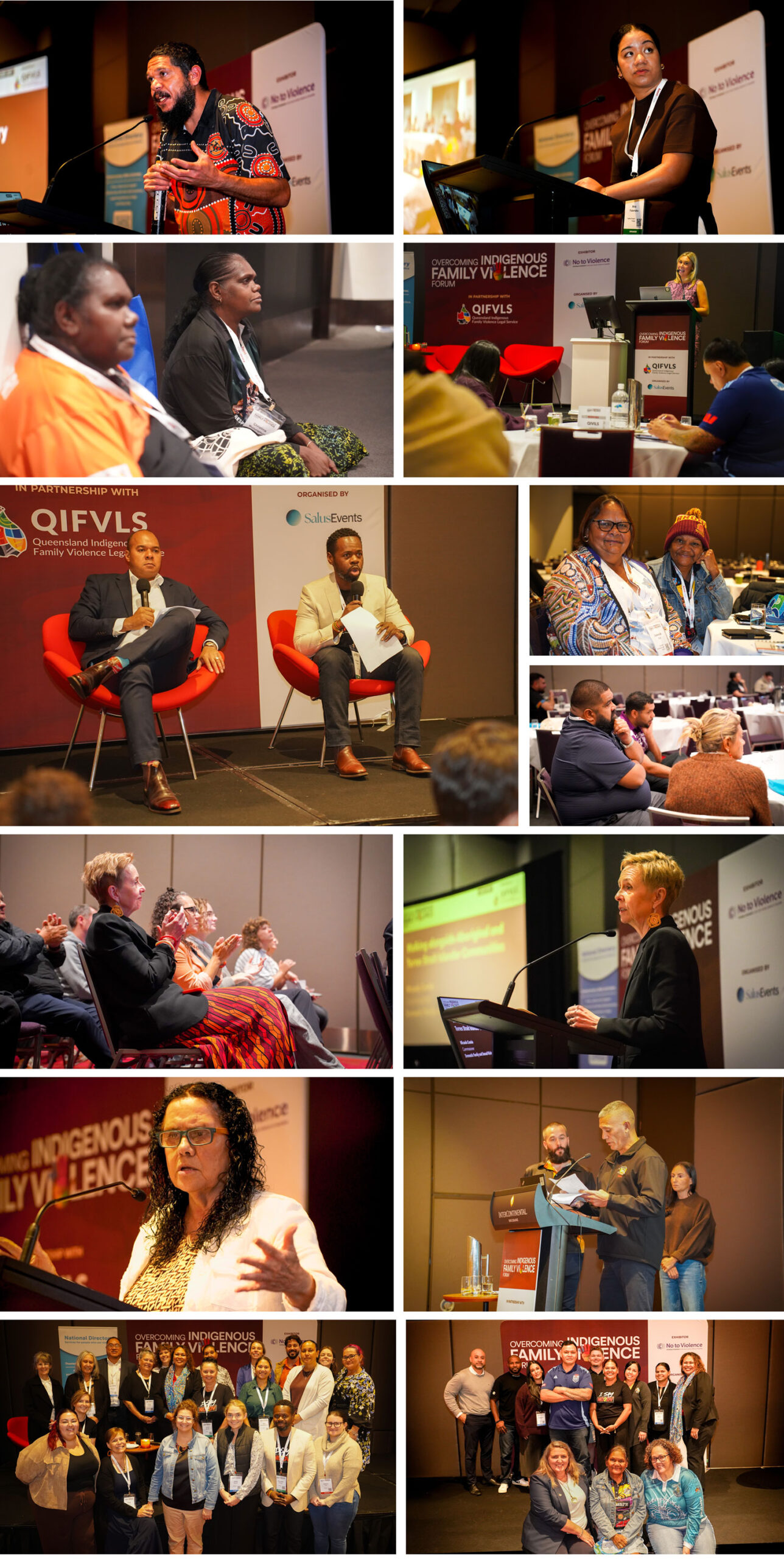
Responding to delegate feedback following the 2025 Forum, QIFVLS were proud to deliver a number of younger voices and emerging leaders on day two of this year’s event, themed: Hope for the Next Generation.
A room favourite turned out to be youth mentor and Talitha Project Toga Ambassador, Ana Falemaka, who spoke with incredible sincerity about: ‘Fostering hope for our young people’.
Another inspiring voice was lawyer and co-founder of Naarm Law Students, Maggie Blanden, who delivered the youth keynote: Our stories, our justice: a young voice for change.
The afternoon session of day two featured a conversation with Barrister Joshua Creamer and QIFVLS’ Senior Policy Officer Kulumba Kiyingi on the subject of the recent Child Safety Commission of Inquiry: Exposing systemic failures to keep Aboriginal and Torres Strait Islander children safe. Both Josh and Kulumba had represented QIFVLS at the Inquiry – for a more in-depth summary of the Inquiry, read the article in the last edition of Our Communities Matter.
Day Three
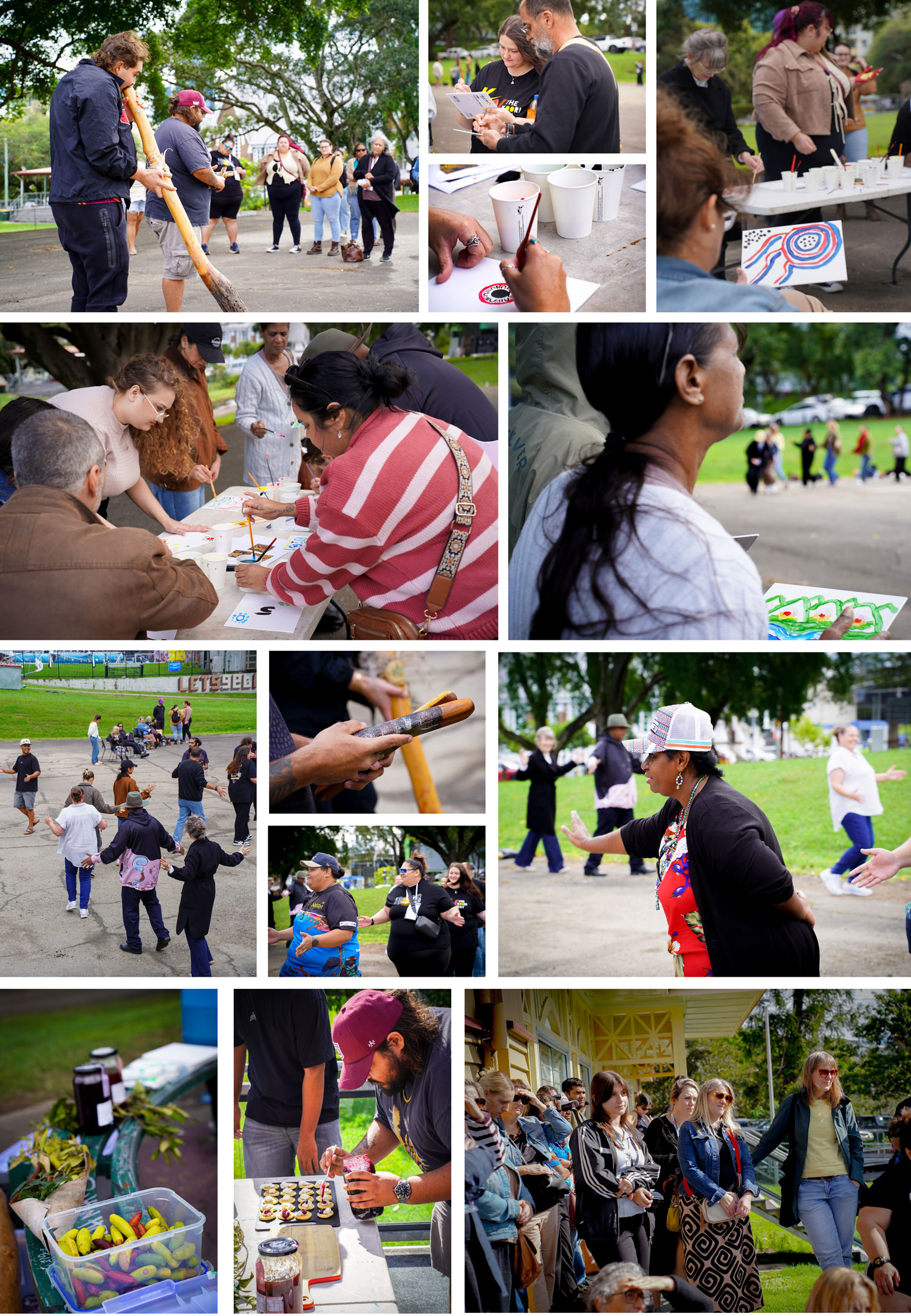
Delegates had the option to extend their Forum experience by attending a day three cultural workshop at Musgrave Park – a place of deep significance for the Meanjin traditional owners.
Local cultural group, Nunukul Yuggera, hosted a morning of spiritual connection, guiding the attendees through a series of immersive cultural activities, including painting, bush food and medicine exploration, and tribal dance.
Musgrave Park Family Fun Day
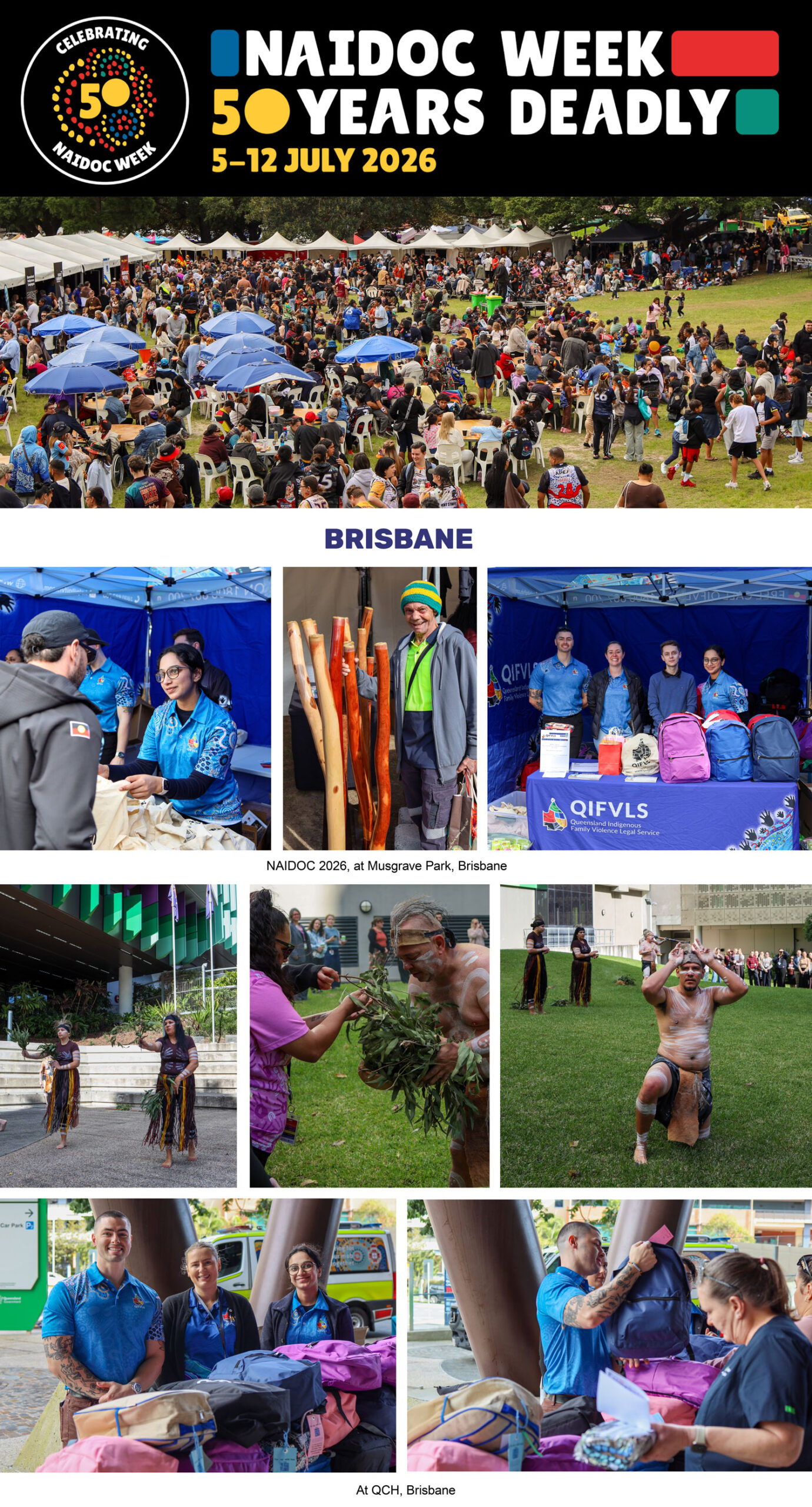
Musgrave Park Family Fun Day drew about ten thousand people as part of NAIDOC Week 2026, celebrating this year’s theme, 50 Years Deadly. The event remains a major fixture of Brisbane’s NAIDOC calendar and featured the Community Elders Lunch, Corroboree, live entertainment, First Nations business stalls, arts and crafts, cultural education, Indigenous food stalls, information services, free amusement rides and keynote speakers.
The main stage opened with MC Moojidi Fogarty and a Welcome to Country from Aunty Deborah Sandy. Speakers included Adrian Burra Gubba, Minister Fiona Simpson, Councillor Vicki Howard, Aunty Cheryl Buchannan and event manager Aunty Natalie Alberts. Dance groups and musicians performed throughout the day, creating a strong sense of celebration across the park.
Our Brisbane team attended throughout the event, handing out goodie bags, information packs, fruit, juice poppers and backpacks donated by Care Kits for Kids Qld. These Care Kits provide comfort, dignity and practical support for children in need, and we are grateful for their generosity. Musgrave Park Family Fun Day offered an important opportunity for QIFVLS to connect with community, share resources and stand alongside families, Elders and organisations. As we mark 50 Years Deadly, we acknowledge the strength of our Elders, the achievements of today and the future of the next generation, and we remain committed to supporting Aboriginal and Torres Strait Islander peoples across Queensland.
QCH NAIDOC Opening Week
Earlier in the week, QIFVLS also attended the Queensland Children’s Hospital NAIDOC Opening celebrations. The event featured a traditional smoke ceremony and cultural dances that welcomed families, staff and community members into NAIDOC Week. Our team hosted an information stall and handed out the same Care Kits for Kids Qld backpacks, along with fruit, juice poppers and resource packs. The opening event provided another valuable opportunity to meet families, share information and support community during the start of NAIDOC Week.
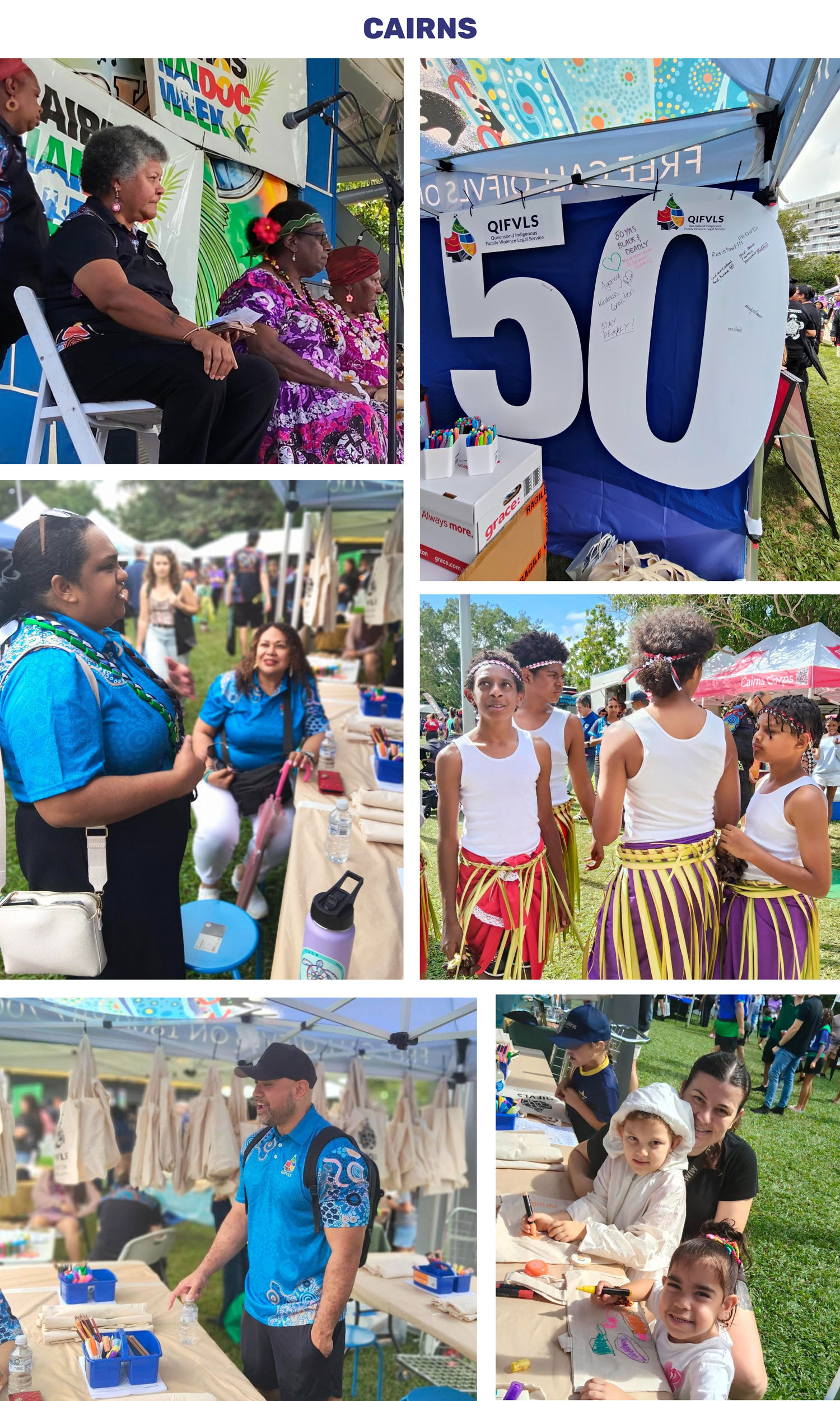
NAIDOC Week in Cairns is always a highly anticipated and well-attended celebration, and this year was no different. For QIFVLS’ Service Delivery, Outreach & Community Engagement and Head Office teams, it’s a calendar highlight with team members walking alongside thousands of others in the traditional NAIDOC march, which stretched from Monro Martin Parklands through the city to Fogarty Park by the Esplanade.
The celebrations continued throughout the day at Fogarty Park where the buzz of live music, performers and food vendors blended with the chatter of family members and row after row of stalls. QIFVLS was at the heart of the activity, with our stall attracting some great attendance throughout the day, and a steady flow of community members stopping by to engage with staff and learn more about QIFVLS’ services. Children particularly enjoyed the activities and giveaways at the QIFVLS stall, including writing on our ’50 Year’ message board.
Overall, the day was a valuable opportunity to raise awareness of QIFVLS services, strengthen community connections, and celebrate NAIDOC Week with the wider community.
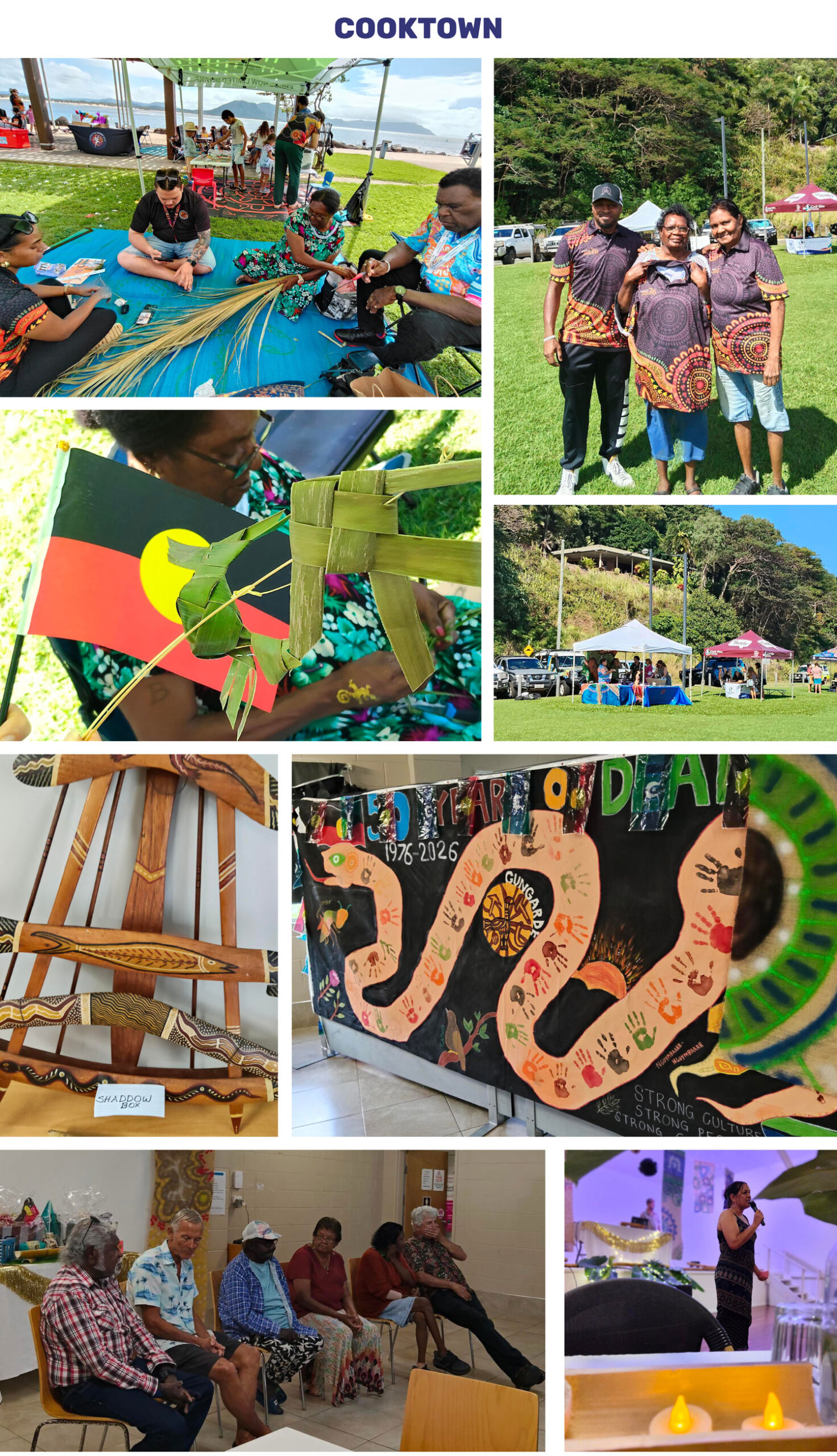
For the 2,700 residents of Cooktown, 300km north of Cairns, NAIDOC week is an important celebration of Aboriginal and Torres Strait Islander achievements and culture. This year, QIFVLS’ Outreach & Engagement Advisor Andrew Adidi was in town to be part of the activities.
Celebrations kicked off with the NAIDOC Ball on Tuesday 7th July at the Cooktown Hall. In addition to local community members, the event was attended by a number of other organisations, including QIFVLS, Gungarde Community Services and the Cape York Family Centre.
On Wednesday, Elders attended a NAIDOC lunch, and on Friday the traditional NAIDOC march attracted both locals and organisation members who made the walk between the Gungarde Centre and Apex Park, where they were able to enjoy all the 50 Years Deadly community day activities.
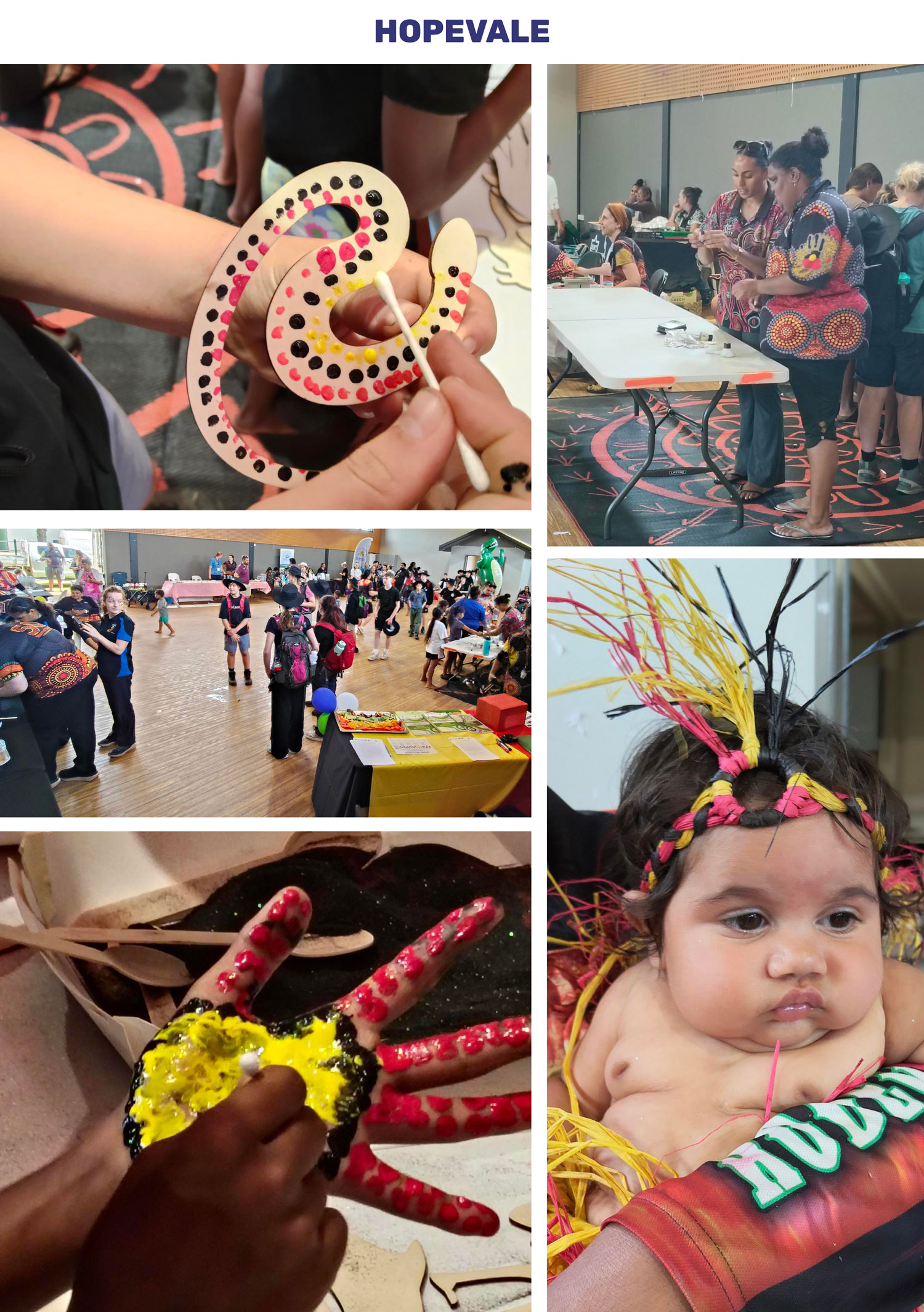
Hope Vale, a neighbouring community to Cooktown with less than half its population, was no less determined to embrace NAIDOC Week celebrations. Hope Vale’s 50 Years Deadly events included a march, community day and a trivia night.
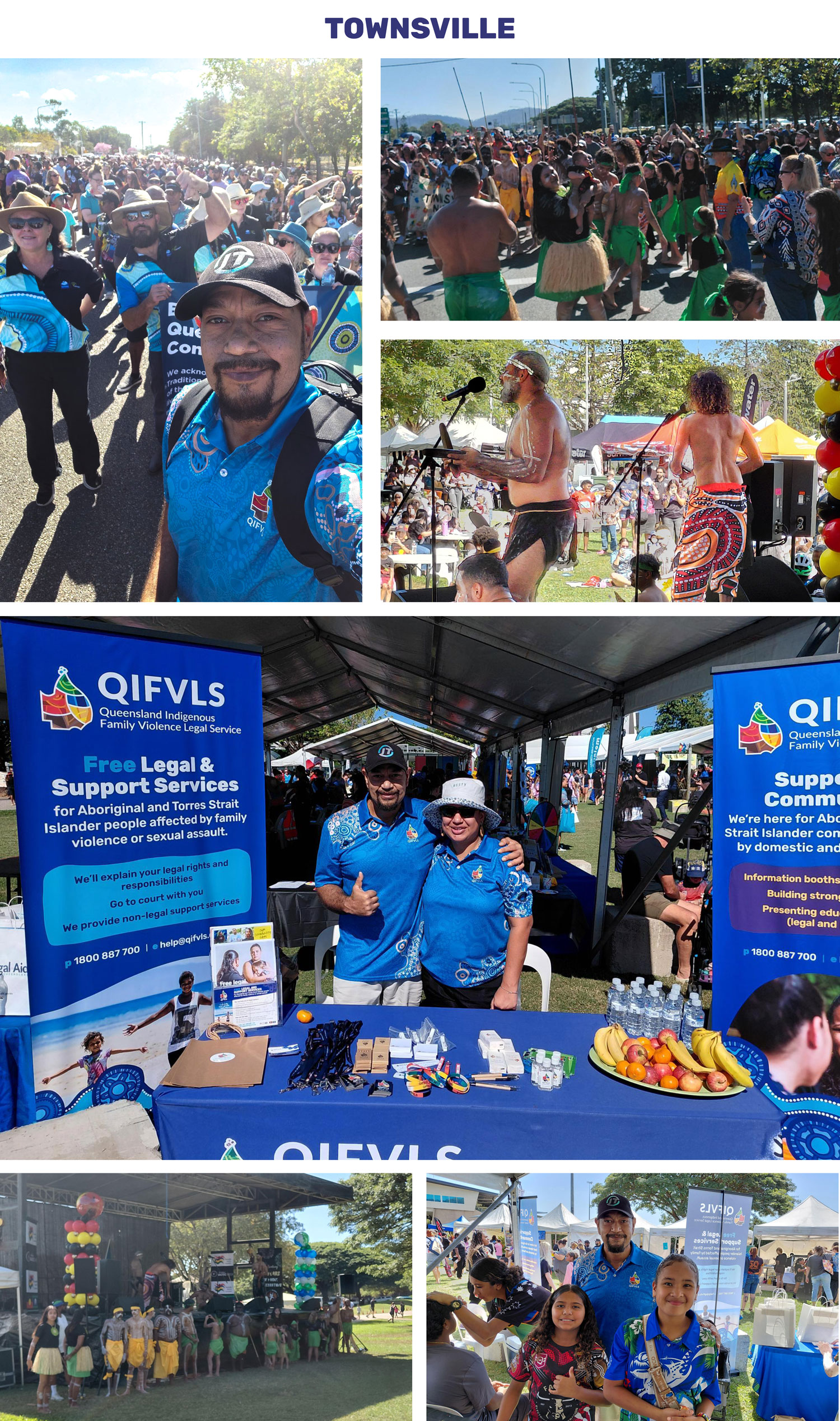
QIFVLS’ Townsville office’s staff members Evan Ah Wing, Kulumba Kiyingi and Jade Murphy participated in their local NAIDOC 50th Year march and Deadly Day Out event, held on beautiful Bindal and Wulgurukaba country. After setting up the QIFVLS stall, they joined the march, which concluded at the Riverway parklands.
Over the course of a busy day, they spent valuable time with stakeholders, other services and the community handing out goodie bags, vital resources and information to families.
Our Townsville team had a fantastic day out connecting with the community at Deadly Day Out. The energy was incredible, with thousands of people coming together to celebrate a massive milestone: 50 Years of Deadly!


QIFVLS is proud to launch our new brand look! As the organisation has evolved with the growth of our services and the introduction of an Outreach and Community Engagement Team, so our branding is changing to reflect this deeper offering.
In 2025, QIFVLS took the rebrand project to tender, with Aboriginal and Torres Strait design agencies from across the country submitting proposals. Ultimately, the project was awarded to Cairns-based designer Leigh Harris of Ingeous Studios. Leigh has traditional connections to the Kangulu people of Central Queensland and Gungarri people of South East Queensland and has been creating powerful, effective and culturally-connected branding for organisations for over 25 years. His client list includes Wuchopperen Health, Mecca, RACQ, REA Group and Target.
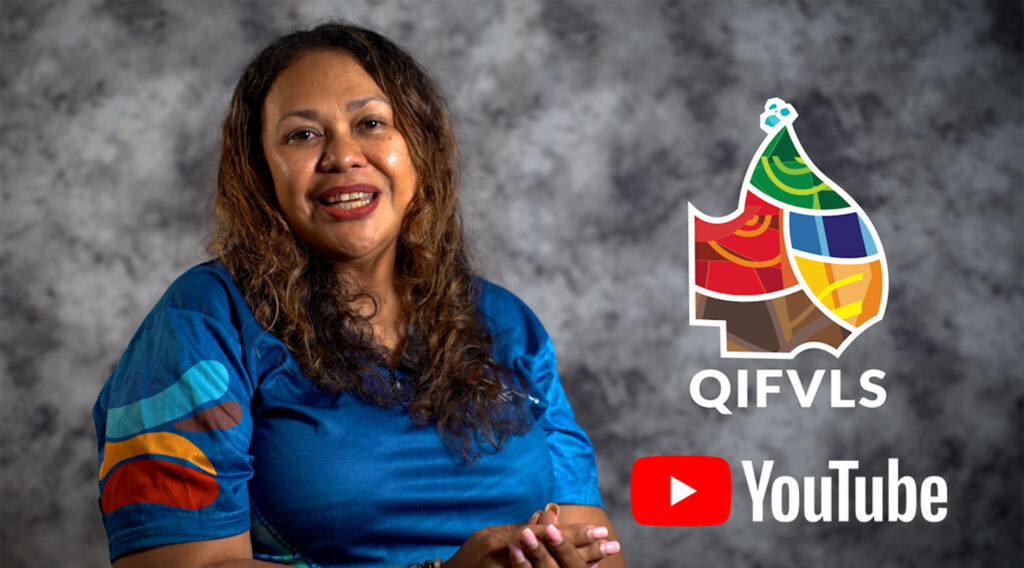
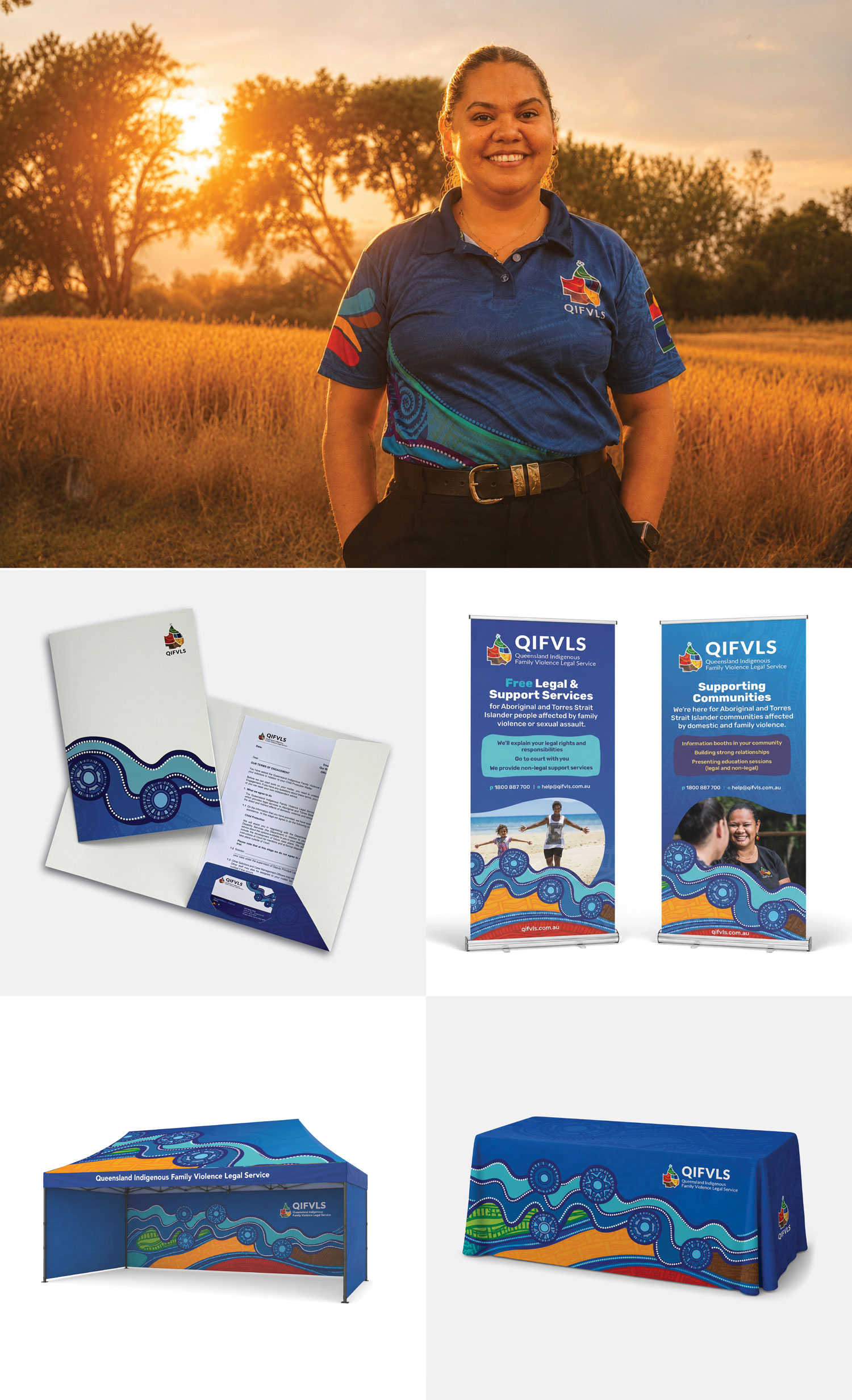
Andrew Keable, QIFVLS’ Communications Manager said, “From the start of this rebranding project, it was important for Leigh to have a clear understanding of the project’s objectives, as well as QIFVLS’ purpose and values.
“As an Indigenous designer, my role is not to create artworks that depict Songlines, Dreaming stories or cultural narratives” Leigh said “instead, I create contemporary design systems that communicate an organisation’s purpose, identity and aspirations while remaining culturally respectful and authentic.
“Every design is developed to reflect the organisation and the communities it serves, rather than borrowing or reproducing cultural stories that are not mine nor the organisations to tell.
“Equally important is ensuring that every design embraces and celebrates the diversity of Aboriginal and Torres Strait Islander People. Queensland is home to many distinct Aboriginal Nations and the Torres Strait Islands, each with their own histories, cultures and identities. My approach is to create visual identities that are inclusive, representative and culturally safe, resulting in designs that genuinely reflect an organisation’s values, strengthen its connection with community and communicate its impact with authenticity and respect”.
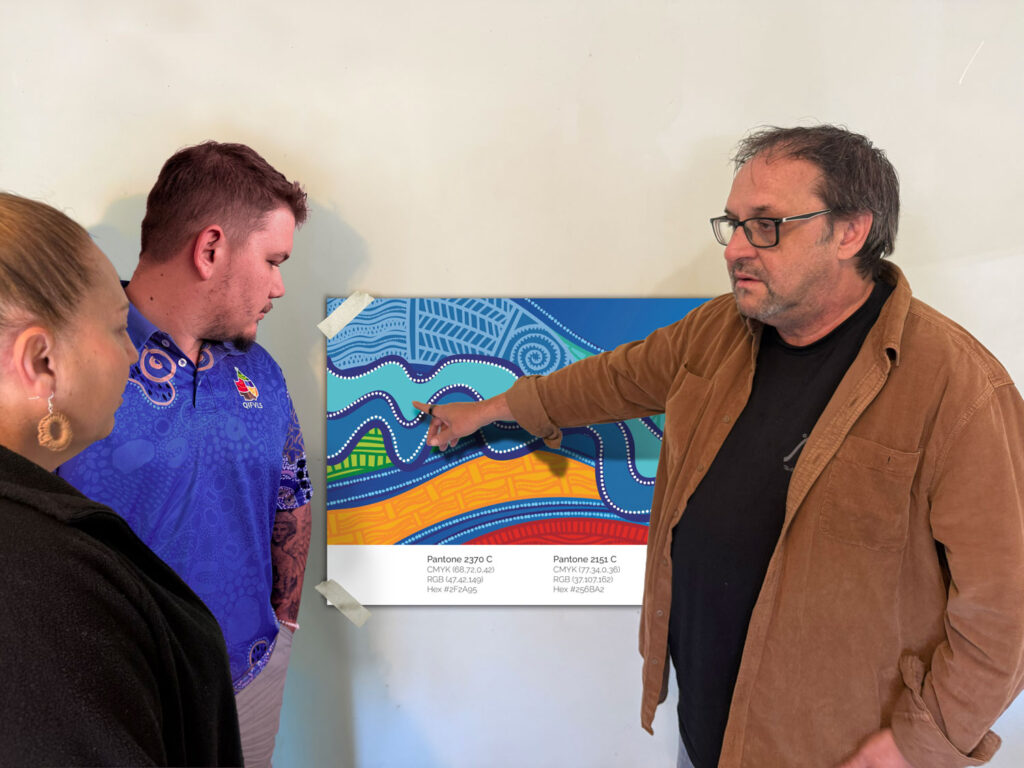
In addition to developing QIFVLS’ new brand language, Leigh made a recommendation to refine the logo, saying, “QIFVLS’ brand mark plays an important role in representing the cultural and geographic diversity of Queensland.
“As part of this brand refresh, the logo’s colour palette has been thoughtfully refined, with the Torres Strait region transitioning from brown to a sea teal that more accurately reflects its strong connection to the ocean. Likewise, the South West Queensland region has been updated from black to brown. Although the black referenced the rich black soil of the region, the use of brown provides a more balanced and recognisable visual representation of the landscape while remaining true to Country.
“As someone whose family is from South West Queensland, I have a personal understanding of the significance of this Country and the stories it holds. This informed the decision to introduce a brown tone that better reflects the broader landscape while maintaining the integrity and intent of the original brand mark.
“These considered refinements strengthen the visual identity, creating a brand that is more representative of the diverse landscapes, cultures and communities that QIFVLS serves across Queensland”, Leigh said.

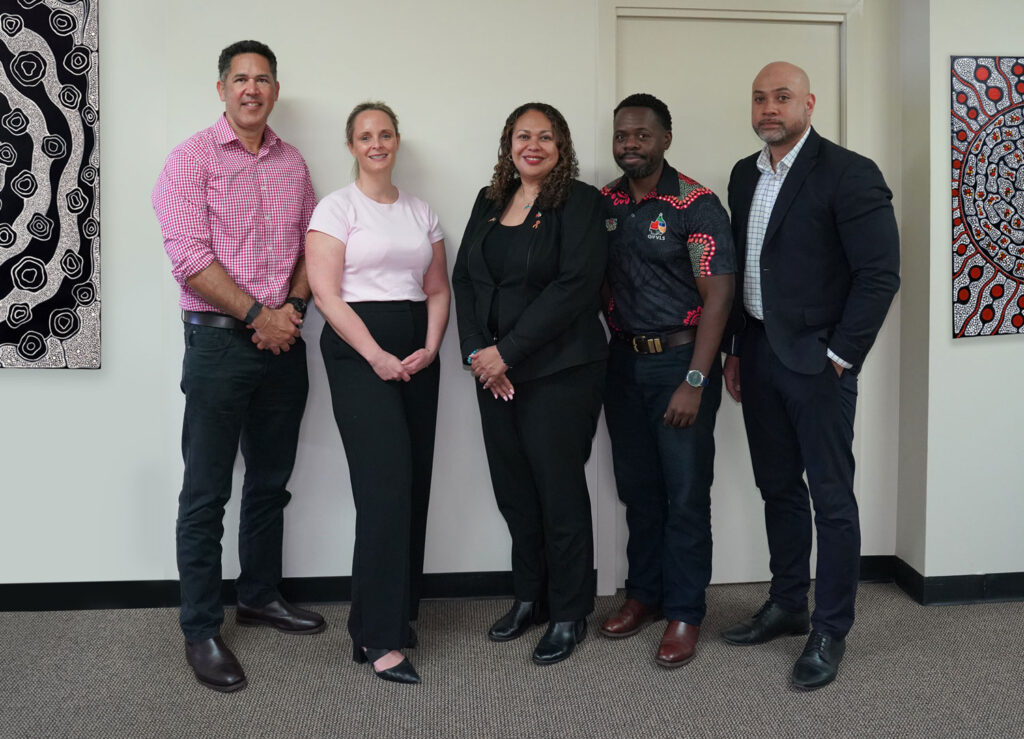
In June, senior QIFVLS staff including Acting CEO Thelma Schwartz, Senior Policy Officer Kulumba Kiyingi and Acting Executive Director Legal Aaron Luki were delighted to host leaders from the Department of Justice at our Cairns Head Office. Aaron Luki commented, “It was a great opportunity to catch-up and exchange introductions with Policy and Reform Deputy Director General, Tessa Piper and First Nations Justice Office, Stephen Tillet”.

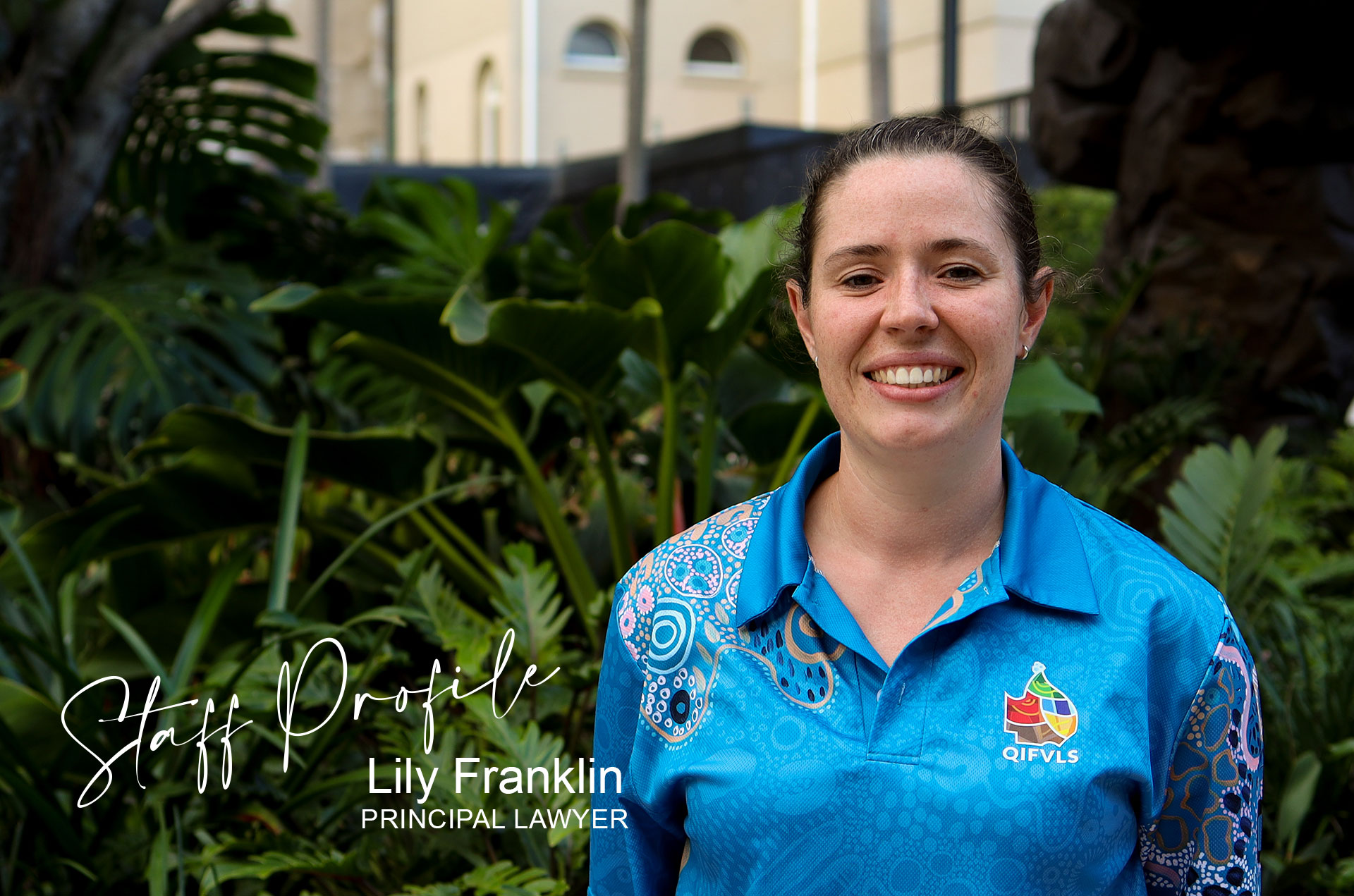
OCM: Hi Lily, where you were born and raised?
Lily: I was born in Adelaide, the fourth child of five kids.
OCM: That’s a lot of competition for wardrobe space.
Lily: Being the fourth, you do get a lot of hand-me-downs. We lived in Adelaide until I was eight, when we moved to Fiji for my dad’s work. He’s now retired but was working in sales and marketing for Coca Cola, and their main Pacific operations are based in Suva. It meant a lot of travelling around the Pacific Islands.
We lived there when I was between the ages of eight and 13, then moved to Canberra for a couple of years before going back to Adelaide where I finished high school and went on to the University of Adelaide (now called Adelaide University).
My mum was a librarian, which was a rather convenient job given how much we moved around. She was always able to find work because there are libraries everywhere.
OCM: The ‘ol Dewey Decimal system is the same anywhere, I suppose.
Lily: Actually, she had a job in Fiji working for the law library, updating it to introduce the Dewey Decimal system. I don’t know what system they were using before, but to try and bring it into the modern age, as it were.
OCM: Did you enjoy your schooling?
Lily: I loved languages, and learnt Spanish, French and Japanese in high school – not that I can remember much of them now, but I enjoyed being in the classroom to learn.
OCM: So you were naturally academic?
Lily: I think so, yes. All my sisters are very different. One’s very musical and another one is very ‘sciencey’ whereas I loved history and English. I had fantastic teachers at the last high school – an all-girls school – and discovered a passion for physics. My physics teacher, who had been a pilot in a previous life, was really keen on getting women into aviation and ran a basic aeronautical knowledge course one afternoon a week during the school terms, which I did in Years 11 and 12.
OCM: How far did you take that?
Lily: I was able to do my licence, including my commercial licence via an arrangement run similarly to an RTO. So I’ve got a ginormous HECS debt but thankfully didn’t need to pay anything out of pocket to do the course. I will chip away at that debt as time goes by. And I’ve also got my flight instructor rating.
OCM: Do you still fly recreate recreationally now?
Lily: I’m taking a little bit of a break at the moment, but the goal would be to fly again. I’d like to volunteer, instructing cadets or something like that.
OCM: Growing up, what did you want to be?
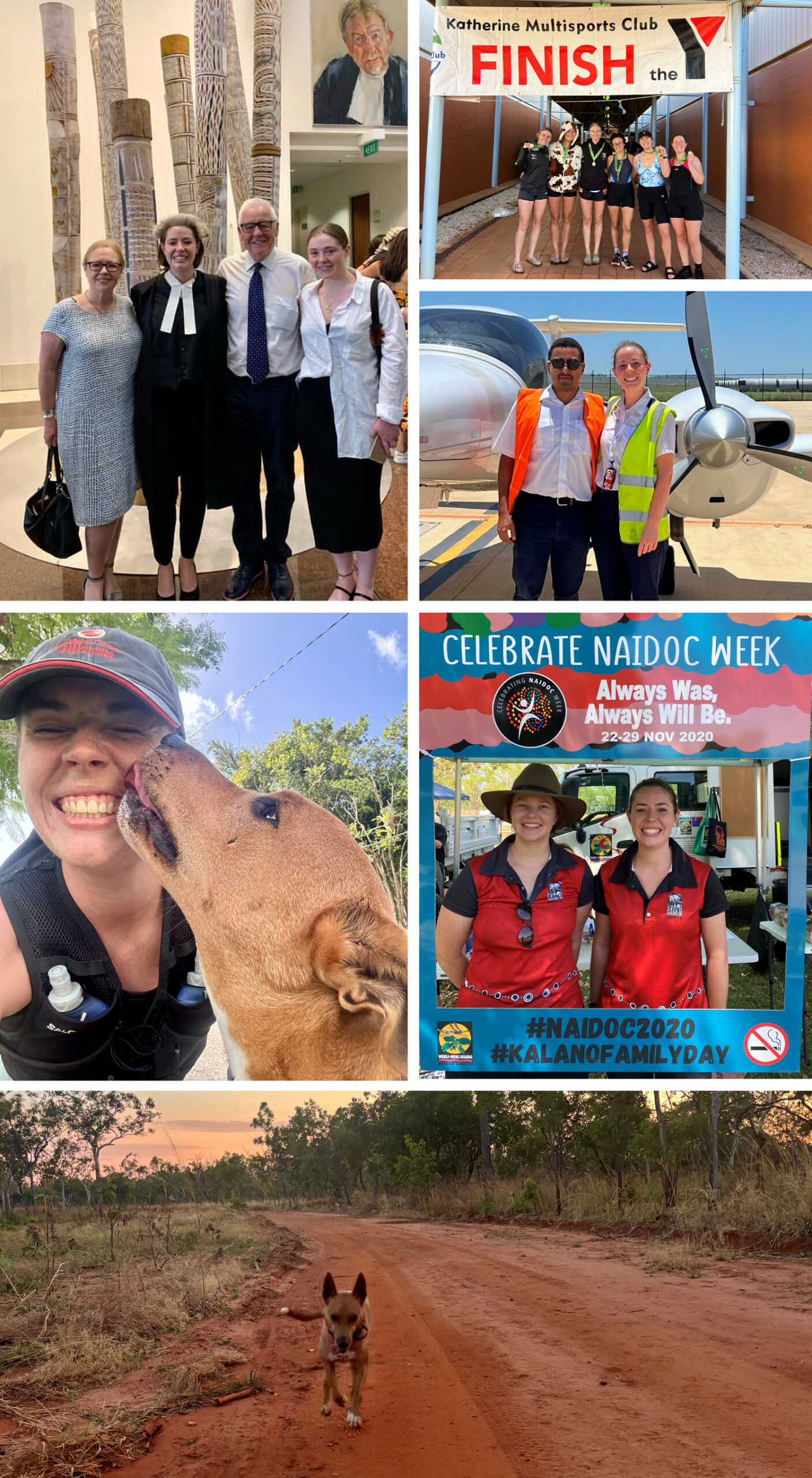
Lily: I really wanted to be a vet. That was a big thing for a long time because I loved animals. We grew up with dogs, and as an adult, I’ve collected my own menagerie of dogs, cats and a blue tongue lizard. But I knew that it wasn’t all about cuddling puppies, and that there was darker side to the job that I wasn’t cut out for.
I was drawn to the law because I quite enjoyed reading and writing, but social work was also something I was interested in. I thought that perhaps having a legal background would be advantageous if I did ever want to go down the social work pathway.
OCM: What interested you about working in the social justice space?
Lily: It possibly stemmed from those years growing up in Fiji. Even early in life, it struck me just how lucky I was, and I could see of that we all have the ability to make things better for others. Mum did a lot of volunteering in Fiji, so we spent a lot of time going to orphanages or helping with the Red Cross trolley in hospitals.
Early in my career, I was working as a paralegal at a private family law firm in Brisbane and became quite interested in family law. In terms of legal areas, that’s probably the one that I found most interesting and relevant because it can be an intersection of social work and the law. But one day, as I was sitting in a private mediation, with a couple arguing over who paid $3,000 for some astroturf, I was like, ‘This is not where I see myself for the rest of my life’. That was my light bulb moment.
At the time, I had friends who were applying for clerkships and graduate programs, either with government departments or big law firms, and I knew that none of it interested me. Then I went on the Ethical Jobs website and saw a paralegal position advertised by an organisation called the North Australian Aboriginal Family Legal Service (NAAFLS) that was based in Katherine, in the NT. I hadn’t heard of either the town or the organisation but read the list of duties that the paralegal had to do, and I was like, ‘Yeah, I can do that’. So applied and got the job.
I was at NAAFLS for three years – one year as a paralegal, and then for two years as a lawyer. After I was admitted, I moved across to the Katherine Women’s Legal Service, where I practiced for a further three years.
OCM: How did you find living in the Northern Territory?
Lily: I loved every second of it. Loved the lifestyle, loved the people, loved the travel opportunities.
The only thing is that it would be a hard place to live for a long time because of its distance from anywhere. It was hard to get home to Adelaide, and in fact it’s hard to get anywhere. It’s a three-hour drive to Darwin, then a three or four-hour flight from there, so basically it takes a day to get somewhere. But in terms of the actual lifestyle there, it was lovely.
I felt so privileged to have had the opportunity to do so much exploring while I was living there – going across to northern Western Australia, through Kakadu National Park and Litchfield National Park in the territory – all really beautiful areas.
OCM: What was it specifically that attracted you about working with QIFVLS?
Lily: I’d been living in Queensland since 2023, working for the Catholic Women’s Legal Service while doing a bit of the FIFO thing and I was starting to get a bit burnt out from all the travel. I knew I wanted to stay living in Queensland but had no awareness of any services or career opportunities in the state. I reckon it was the first day started seriously looking that I noticed that QIFVLS had posted a job advertisement. I knew of QIFVLS because I’d referred a few clients there who were based in the Northern Territory but who needed to have legal work done in Queensland.
It was like someone was looking out for me because this QIFVLS job was pretty much asking for exactly my level of experience and background. I was like, ‘This just seems too good to be true’.
OCM: And what do you like to do on your days off, or your weekends?
Lily: I’m training for a marathon at the moment! I’m doing the Sydney Marathon at the end of August, so yeah, I’m doing a lot of running and a lot of eating and sleeping.
Plus I’ve just recently got a foster dog, a puppy, to add to my animal family of two cats, a blue tongue lizard and my older dog – so I’m spending a lot of time trying to puppy-proof the house. She keeps being one step ahead of me in terms of the things that she’ll find to eat.
OCM: You’re a brave person taking on a puppy, especially when you’re not working from home.
Lily: I’m very lucky. My older dog is a five-year-old kelpie, that’s very well trained. We’ve done like a lot of obedience and agility training together, and now he just seems to be training her up as well, which is great!
OCM: Being a Kelpie, he’d love going out for a run with you.
Lily: He comes on all my training runs. We went for a 26k run last week. I was buggered by the end of it, and he was fine.
He’s an ex-camp dog from a community just outside of Katherine and 98% muscle.
OCM: I think he’s found the right owner with you. Thanks Lily.

Are you in search of a rewarding profession that will take you on journeys through the breathtaking landscapes of Queensland? One that promises not only career advancement and skill enhancement, but also attractive perks, substantial travel allowances, and one-of-a-kind professional adventures? Are you drawn to a career that enables you to make a positive difference in the lives of others?
Look no further – your new career awaits you! At QIFVLS, we are dedicated to combating Family and Domestic Violence within Aboriginal and Torres Strait Islander Communities. Our methods encompass education, advocacy, legal reform, court support, and casework assistance. By focusing on early intervention and prevention, our aim is to empower individuals impacted by Family Violence to regain control over their lives. We are in search of outstanding and dynamic individuals who can join us in achieving this mission.
Check out our latest job opportunity listings, here.


When an individual or organisation makes a tax deductible donation to QIFVLS, they can be confident that their funds are going towards making a tangible difference to the safety and welfare of Aboriginal and Torres Strait Islander people experiencing or at risk of domestic and family violence.
Our team are grateful for all donations that help our not-for-profit organisation to continue offering this critical service. Donations of $1,000 or more help fund outreach services to some of Queensland’s most remote ATSI communities.