


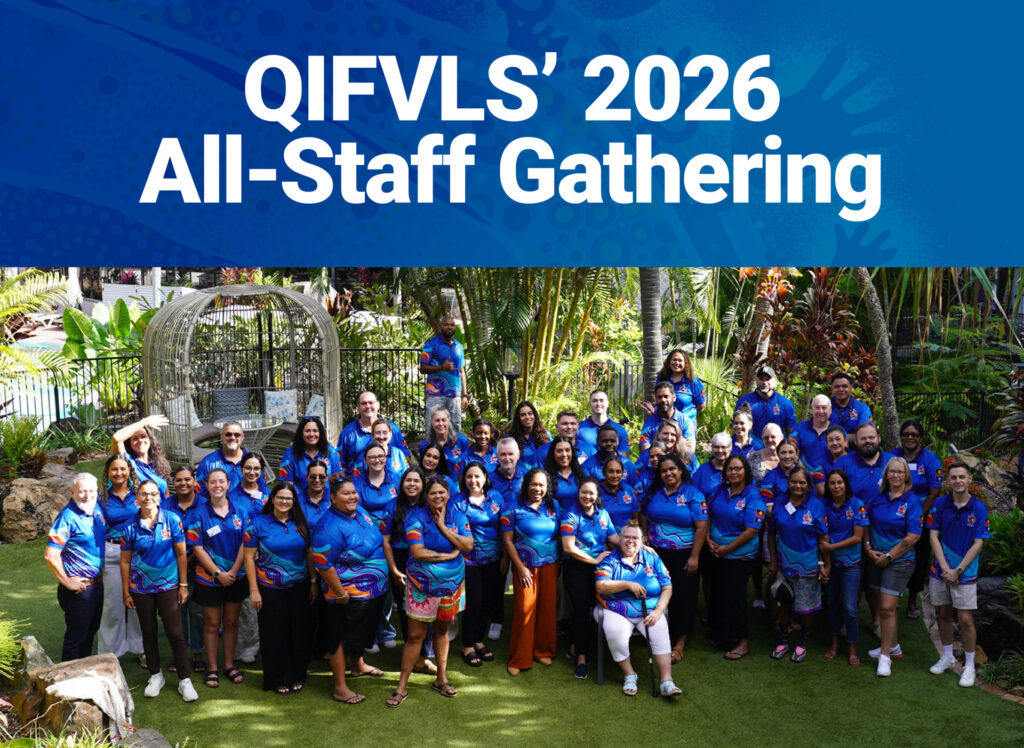
The QIFVLS team came together from across the state in April for our 2026 All-Staff gathering. This annual event provides an important opportunity for our staff to be introduced to new directions in the organisation, to hear updates from each of the offices and departments, and to reconnect with other team members who they may only see once a year.
This year, our All-Staff event was held in Airlie Beach, north of Mackay, which offered staff the chance to step away their familiar locations and enjoy a few days away to reset, share, learn and relax.
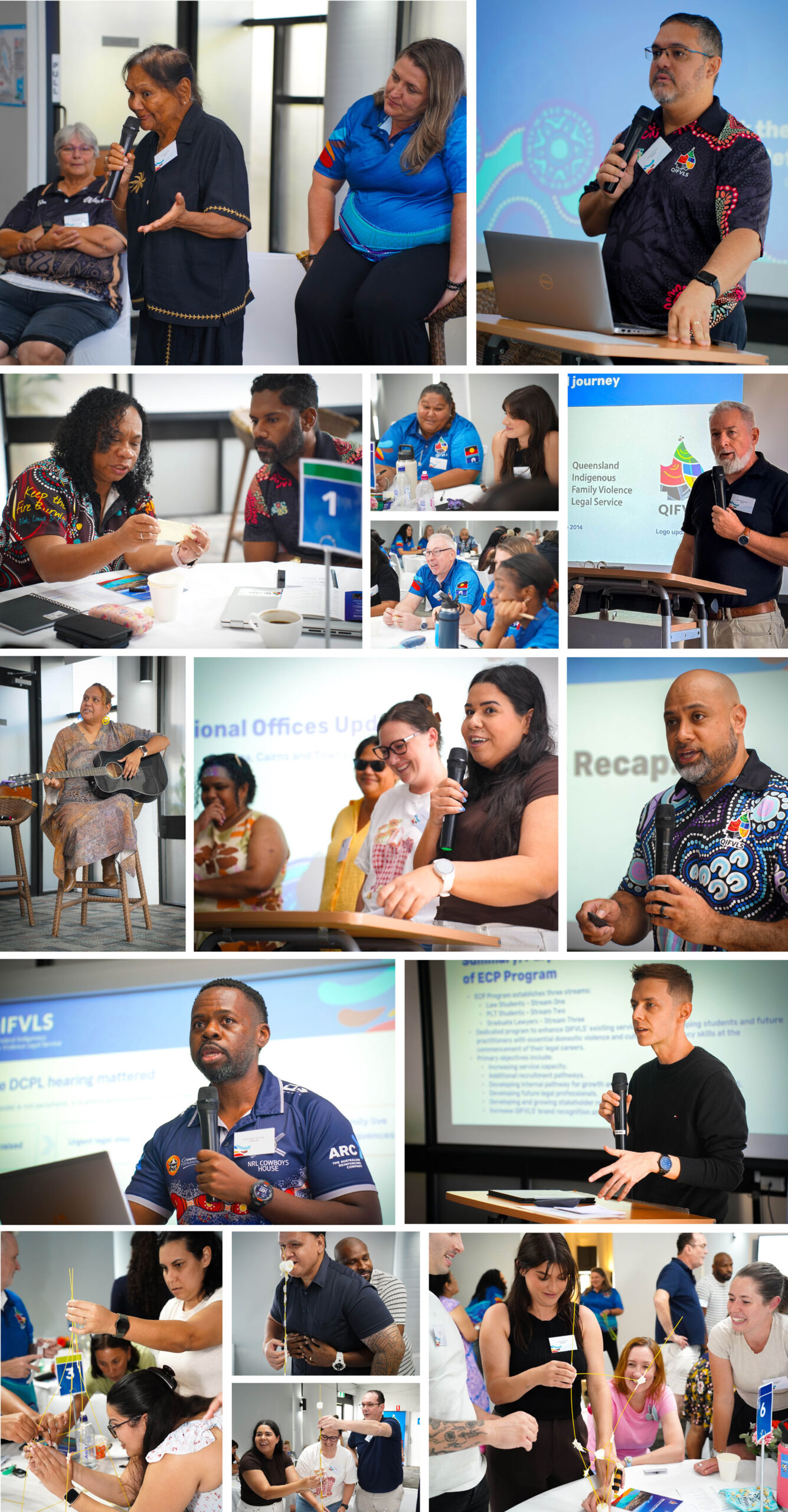
After a travel day on the Monday, the All-Staff gathering kicked off the following morning with an introduction from our MC, Talicia Minniecon, and a Welcome to Country and welcome song by Robert Congoo from Yooribaya Cultural Experiences.
CEO Wynetta Dewis set the tone for the event and introduced the QIFVLS Board, who provided an update for the year.
A series of fun, staff connection challenges broke up the business of the day, followed by light refreshments.
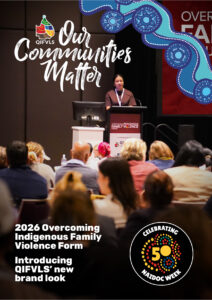
Before lunch, Communications Manager Andrew Keable unveiled an exciting brand refresh for the organisation ahead of its public launch in June, and guest speaker Elaine Crombie entertained with a mix of anecdotes and song.
The afternoon session included regional office updates and a ‘What’s new in Legal’ presentation, followed by a team challenge, entitled “collaboration” where each table worked together to build the highest self-supporting structure out of uncooked spaghetti and some carefully rationed adhesive tape – with results that were funnier than they were effective.
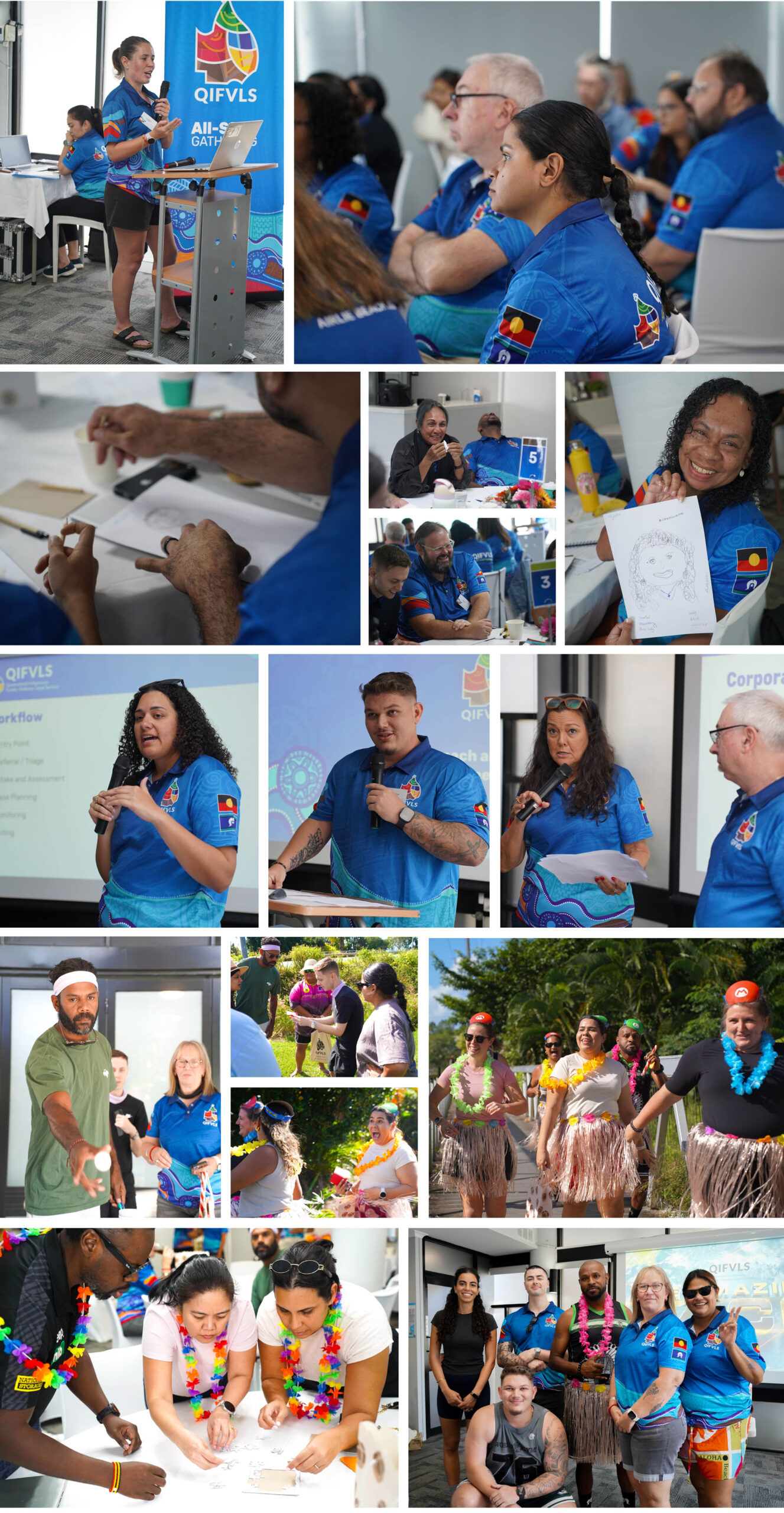
Wednesday included updates from our Brisbane, Rockhampton and Mount Isa offices, the Outreach and Engagement Team, Corporate Services and Finance and a presentation by People and Culture Manager, Jaide Southee.
This year, ‘The Amazing Race’ returned as a feature of the QIFVLS All-Staff gathering, with each table competing against the clock to win a series of problem-solving challenges spread across the resort. Resort staff and other guests stopped in their tracks as six crazily-dressed groups passed through, with ‘The Vipers’ announced as the winning team – congratulations to Mandy Tedeschi (Captain), Brandon Begley, Lateesha Johnstone, Nubayesha Ali, Kaleb Cohen and Sharni Ellison.
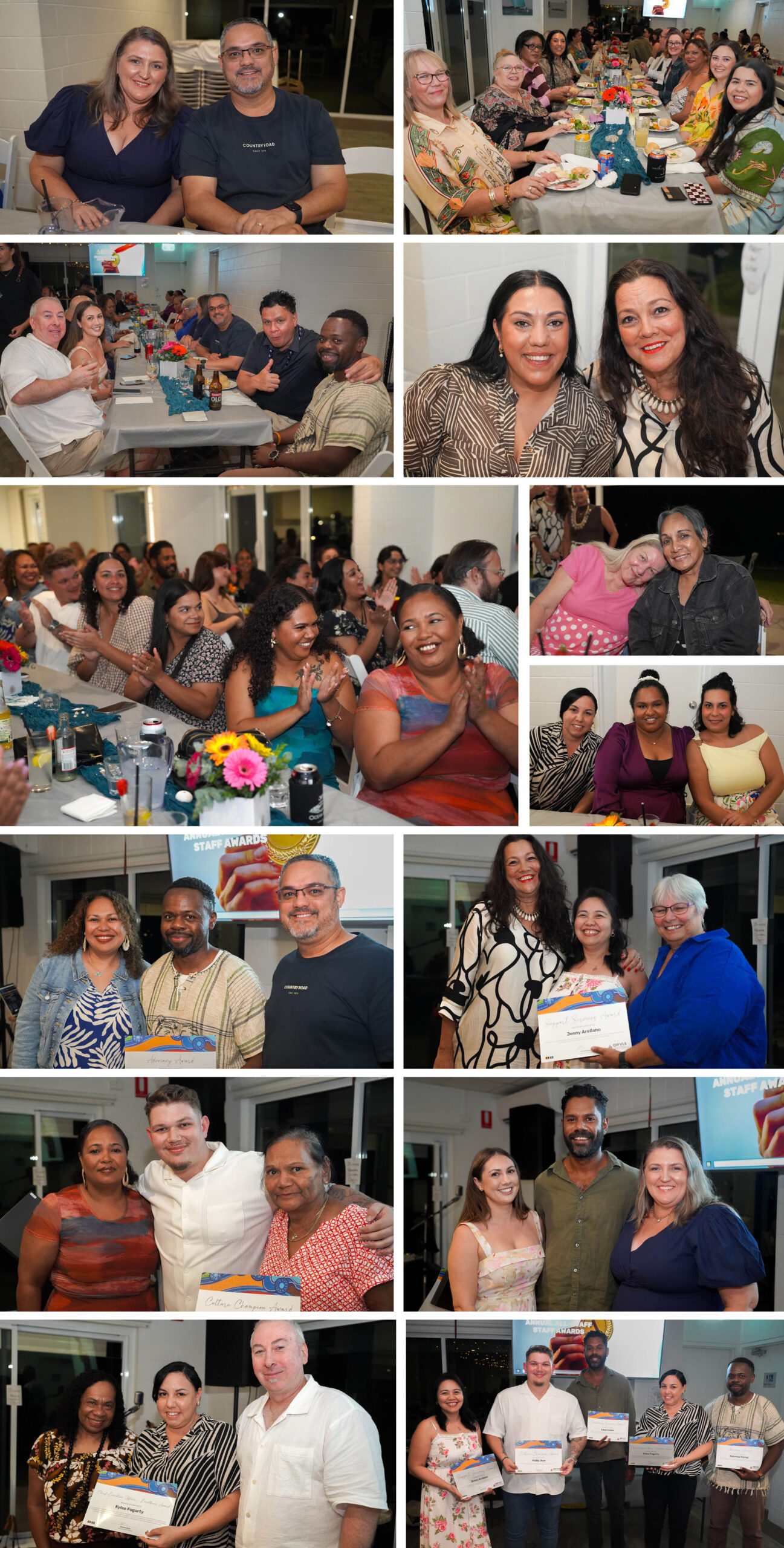
The All-Staff Awards and Dinner was held at the Whitsunday Marine Club on Thursday. What followed was a wonderful evening, capped off by recognising some outstanding efforts by individual team members over the year.
These awards included:
Advocacy Award – Kulumba Kiyingi
Community Service Award – Kaleb Cohen
Support Services Award – Jennifer Arellano
Culture Champion Award – Phillip Jose
CEO’s Excellence Award – Kylee Fogarty

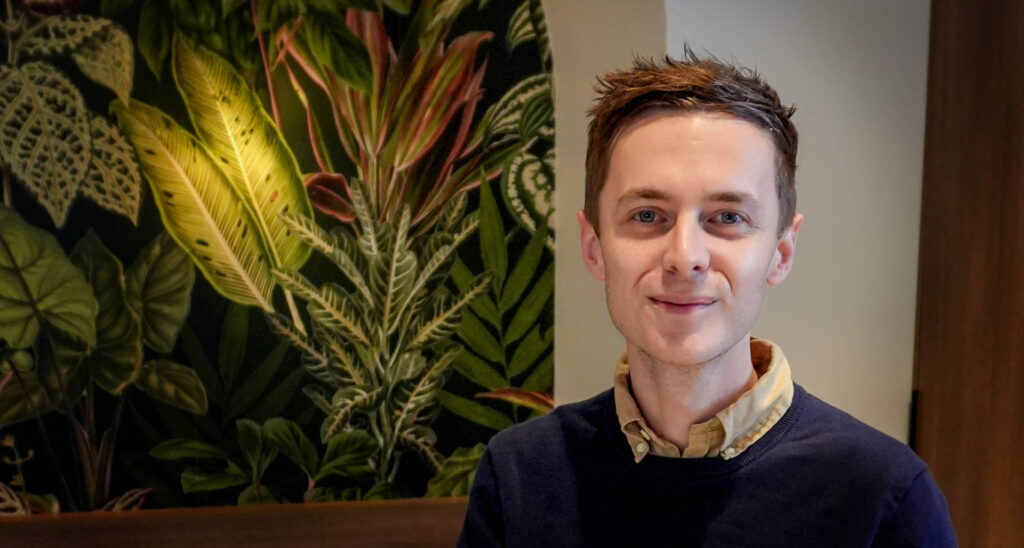
In April, we celebrated one of our very best, Brandon Begley, who has been recognised in the 2027 Best Lawyers: Ones to Watch in Australia for his outstanding work in Family Law.
This honour is based entirely on peer review, making it one of the most trusted measures of legal excellence in the profession. It reflects not only Brandon’s deep expertise and unwavering ethical standards, but also the qualities that truly set him apart which are his humanity, his ability to connect and his commitment to guiding people through some challenging moments in their lives.
The QIFVLS team couldn’t be prouder. Congratulations, Brandon, this recognition is well deserved

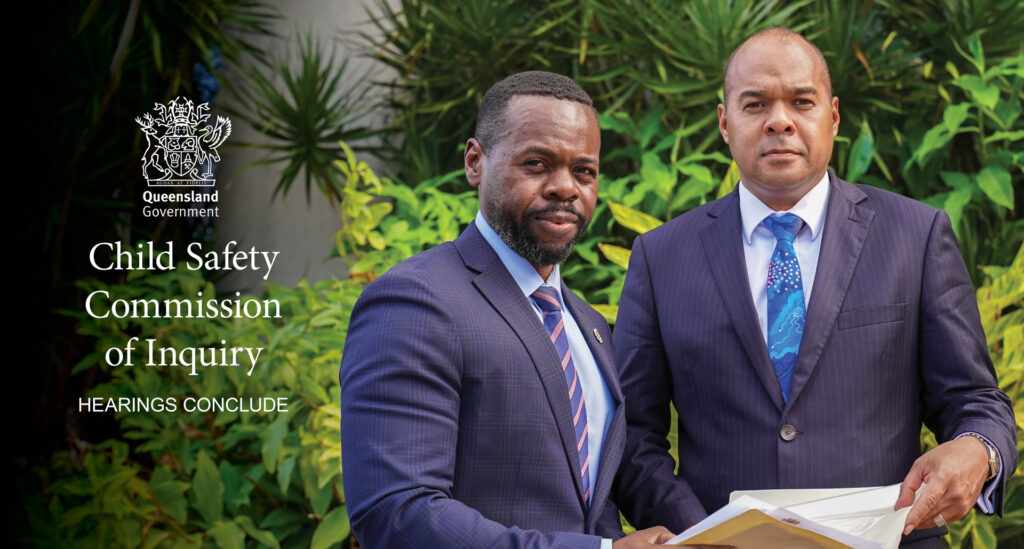
QIFVLS’ Final Submission to the Child Safety Commission of Inquiry
Queensland’s child safety system is failing Aboriginal and Torres Strait Islander children and families – not at the margins, but at its core. That is the central message of QIFVLS’ final submission to the Child Safety Commission of Inquiry, prepared and lodged in late March.
Our submission draws on the direct experience of our Lawyers, Case Managers, Family Advocate Support Workers, and Outreach & Engagement Advisors as they assist families navigating the child protection system. Across a year of public hearings and written submissions to the Commission, the same themes kept emerging. The same failures kept repeating.
The system intervenes too late and too coercively
The clearest pattern across all of our submissions is that support consistently arrives too late, while coercive intervention arrives too early. The system is slow when it comes to identifying kin, engaging Aboriginal and Torres Strait Islander Community Controlled Organisations (ACCOs), providing therapeutic support, and responding to disability and mental health needs. Yet once a matter moves toward removal or urgent legal action, it moves fast.
This timing problem is especially acute around pregnancy and newborns. Evidence before the Commission showed delayed engagement, hospital-based planning under pressure, and removals happening after hours or at the bedside and without adequate cultural consultation, written reasons, or ACCO involvement. We submitted that Queensland urgently needs a mandatory domestic and family violence-informed perinatal protocol to change this.
Domestic and family violence is the starting point
DFV is not one issue among many in this system, it is the principal upstream driver of Aboriginal and Torres Strait Islander children entering child protection and later coming to the attention of youth justice. Yet the system too often assesses victim-survivors through a lens of failure, while the conduct of people using violence is under-weighted or made invisible.
Our clients have told us directly that they fear disclosing violence because they expect it will lead not to support, but to the removal of their children. That fear is rational. It is also a systemic failure that must be addressed.
Family is not absent, it has been blocked
One of the most important propositions in our submission is this: family is not absent. In many matters, family members have been administratively obscured, procedurally exhausted, or practically blocked by the operation of the system itself. Blue Card delays, travel and distance barriers, housing requirements, fragmented services, and fear of government involvement all prevent kin from being identified and supported in time.
This is particularly acute in regional Queensland where geographic distance and service scarcity can make a family connection practically impossible without active State assistance.
Culture must carry real authority.
Cultural Practice Advisers (CPAs) and ACCOs are too often brought in after decisions have already hardened. Their advice is too often ignored without recorded reasons. Our submission calls for CPAs to be properly resourced and empowered to genuinely shape assessments, placements and litigation, and not merely tick a consultation box. Cultural authority cannot remain advisory. It must be operational.
Legal accountability is too thin
The Commission heard significant evidence about Queensland’s child protection litigation model. Our final submission argues that when the State exercises coercive power over a child and family through urgent removals, ex parte applications, or major placement decisions, there must be clear, recorded legal scrutiny at that moment. A system that cannot prove what it says it values will keep reproducing unfairness.
We are also calling for structured pre-proceedings pathways, earlier court-ordered conferencing, and a specialist child protection court drawing on the strengths of models like Dandjoo Bidi-Ak in Western Australia and Marram-Ngala Ganbu in Victoria.
Removal does not end violence
Evidence from the Youth Justice public hearing in Toowoomba made plain that children in care can remain exposed to sexual violence, coercion, and exploitation — without the protective responses that would ordinarily be expected of a capable parent. Placement instability, residential care, motel use, police station holding, and self-placement can compound trauma and, in too many cases, contribute directly to criminalisation. The link between child safety and youth justice is structural, foreseeable, and in many cases preventable.
What we are asking for
Our 14 consolidated recommendations call for systemic reform across the full arc of a child’s journey through the system.
The most significant of these recommendations include:
- A statewide Child Protection Notification and Referral Scheme, ensuring early ACCO and legal service involvement from first contact
- A mandatory DFV-informed perinatal protocol governing engagement around pregnancy, birth, and the newborn period
- A mandatory early family-finding and kinship pathway, with practical barriers treated as problems to solve rather than proof of unavailability.
- Stronger cultural authority for CPAs and ACCOs, with departures from cultural advice recorded and reviewable
- Mandatory front-end legal accountability at coercive decision points
- A family-based care first strategy, with residential care as a genuine last resort
- Rejection of legal adoption as a permanency pathway for Aboriginal and Torres Strait Islander children – permanency must be understood through identity, kinship, culture, community, and Country
Our position
Queensland’s child safety system is not failing at the edges. The evidence before the Commission confirms deeper structural problems. Reform must be approached as a whole-of-government responsibility and as a Closing the Gap obligation. QIFVLS respectfully urges the Commission to make findings and recommendations that reflect the full weight of that evidence.





In this edition’s Blakchat, Phillip Jose (PJ) QIFVLS Community Development Manager, yarns with Outreach Engagement Advisor Andrew Adidi about the importance of providing a consistent presence in community and delivering education about domestic and family violence.


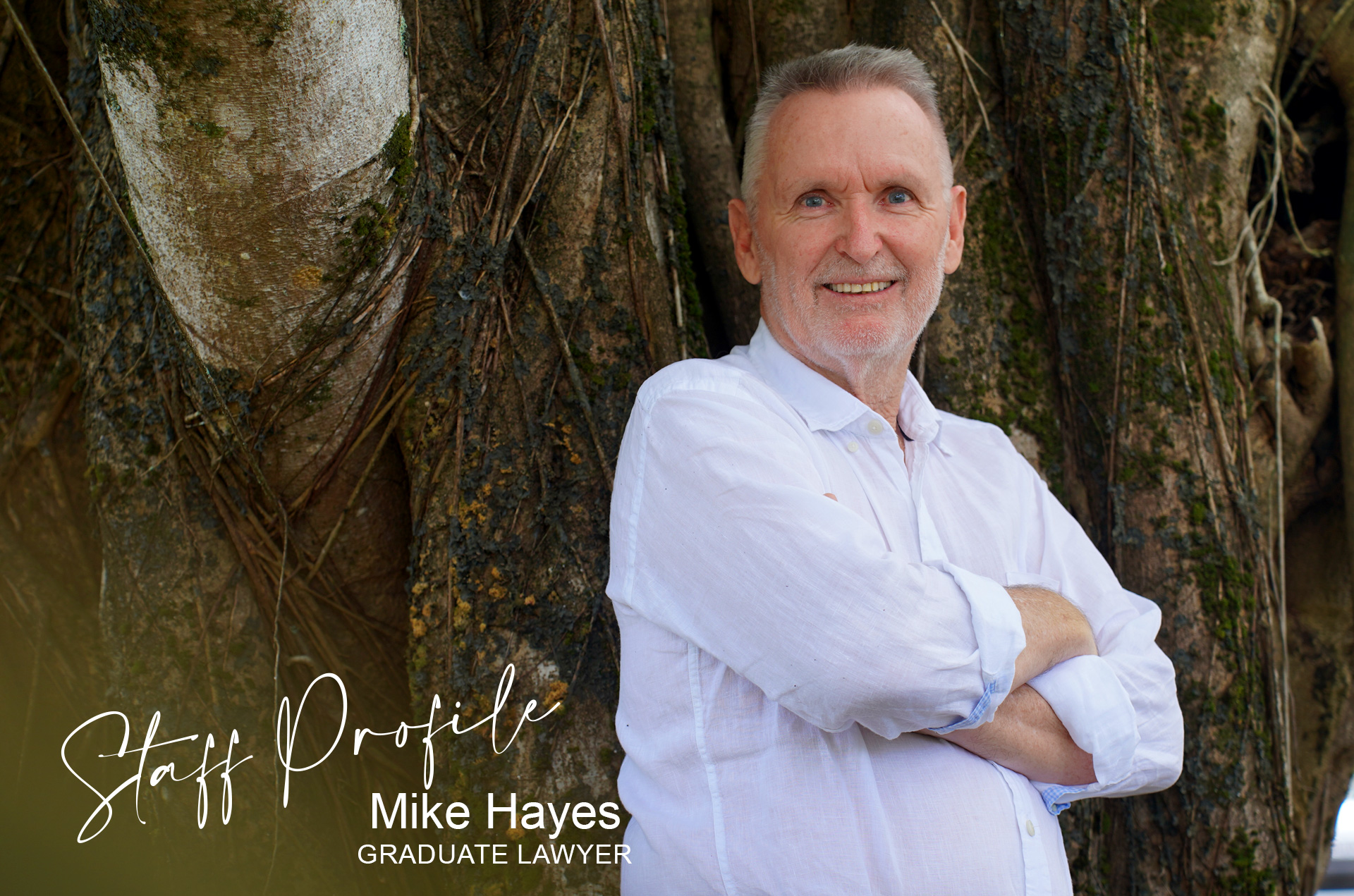
OCM: Thanks for sharing your story Mike. I know from previous conversations you’ve led a very interesting life! But let’s start with where you were born and raised.
MH: I’m originally a Kiwi and was born in Rotorua, although I think I’ve lived in Australia longer than I lived there.
With my dad’s work he’d get reposted every 18 months to two years, so we were a mobile family and lived in a lot of different places – which meant I don’t really have a hometown. We lived in Timaru, Tomuka, Wellington, Auckland and other places on both the North and South Islands.
I’ve got two sisters – one older and a younger one. We’re a fairly driven family in our own ways. My older sister is very musical. She teaches piano, runs several choirs and is currently writing a PhD in choral work. My younger sister is equally driven and has degrees in psychology, nursing and law.
Because we were always moving around and went to so many different schools, I struggled to settle and stay motivated. In one of my reports in one of my sixth form reports, the physics teacher wrote, ‘This year has been a complete waste of your time’. I achieved very good marks at school, I just didn’t find it motivating.
I qualified to go to university, but didn’t go. If I wasn’t motivated by school, I certainly wasn’t motivated by the idea of university.
After finishing school my father put me in touch with a contact of his who ran the only BMW dealership in New Zealand at the time, where I was offered an apprenticeship as a motor mechanic.
It was a great period to be in that industry, working on BMWs like the 3 litre CSIs and the 2002. We serviced Jensons too – which is a brand that no longer exists unfortunately. The Jensen Healy had beautiful Lotus two litre twin cam engine with side draft carburettors that I learnt to tune by ear.
I enjoyed my apprenticeship, and after I finished at the age of about twenty, I did the first year of an engineering degree but still struggled with motivation. That’s when I discovered that the local Auckland Technical Institute (now TAFE) offered a Certificate of Computer Technology, which I thought sounded pretty interesting – particularly as this was in late 70’s, early 80’s and computers were in in their infancy.
So I did a Certificate of Computer Technology while working at Auckland University in the psychology department – designing and building their experimental equipment. Now that really did interest me, and I spent three or four years there. Working the psych department, you’re amongst intelligent staff who were always up for up for a conversation. Even as a pretty lowly technician, people would still respect you because you’re working alongside them to achieve a result.
I really enjoyed my time working at Auckland Uni, and it set me up for a lot of what followed. Because I’d improved my knowledge about electronics and done a lot of the design work, I went to Scotland and worked for a business called Sherring Weighing which made electronically controlled weighbridges.
I would have happily stayed in Scotland but my Scottish girlfriend at the time wanted to come to Australia, so back I came and got a job working for an American business making ‘workstations’, as they were called then. We don’t have an equivalent now but they were basically a high-end PC.
It was in the days of Pentiums and the business, named Apollo, made workstations which would be used for high-end graphics work. I stayed with them until they were bought out by Hewlett Packard – which had corporate philosophy that I didn’t agree with, so I went to company called MIPS – who at the time were making the fastest computer processors in the world.
So through that career arc, I went from working as a technician at Auckland Uni to being employed as an Engineering Manager and later as a Director in that role for major American companies.
During those days back in the 90’s, I was working all over the place – Cairns, Sydney and back in New Zealand. It was mostly for these big American companies in the very early days of the internet. I also spent quite a bit time as a diving instructor with Mike Ball and Diver’s Den.
It was also the period when I learned to fly, starting with fixed wing aircraft and later on helicopters. By about the year 2000 I was working for another technology company called XT3 which allowed me enough time off to gain my commercial licence on both aeroplanes and helicopters.
Leap forward a few years and I’m living in Cairns permanently, working as a diving instructor. There was an Apple computer store on Anderson Street in Cairns, which was in receivership, so I bought some of the assets and got the contract to have the Apple store here.
OCM: What era was that?
MH: That would have been between 2001 to 2007. It turned out to be possibly one of the worst choices of my life. The Apple financial model made it very hard to make money as a dealer. We were a prime, dedicated Apple retailer, but I could send a staff member down to Myer and they could buy the same products cheaper than we could get them at a wholesale price. All our margins were in servicing, not selling Apple products – which was supposed to be our core business.
That experience cost me a vast amount of money. As you’ve heard, I’ve done a few different things in my life and some of those choices worked and others didn’t, but I don’t mind giving anything a go.
So that first slab of my life was about being an engineer, and then the next slab, for the next 20 years, is mostly is about being a pilot.

Because I had aeroplane and helicopter licenses I started working for the Aero Club in Cairns. Then I got a job flying helicopters on Horn Island, and I lived up there for a year. Eventually I’d done enough helicopter flying that I could get an instructor’s rating, so by about 2008 I was back in Sydney, teaching people to fly helicopters. I loved that job!
OCM: What was so good about it?
MH: Well, you’re out in the sun. You’re teaching people to do something they love. It’s something very few people get to experience. If you cast a net around the QIFVLS offices, very few people would have been a helicopter, let alone flown one.
I ended up teaching for an operator on the Sunshine Coast, called Chopper Line – a very high profile, very good flying school. They had an both aeroplane flying school and a helicopter flying school, and because I had both instructor ratings, I eventually ended up being the chief pilot there.
That was a really good job where I stayed for about three years, before I joined a helicopter organisation in Mackay called Aviator Group, flying marine pilots out to ships and back again.
I moved there as the Training and Checking Captain. It was, and still is, an all-weather operation, 24 hours a day, going out, landing on ships, and coming back again.
We operated out of Mackay, Gladstone and Port Hedland. I loved that, flying expensive helicopters out to ships. We went to Germany to pick up two brand new, $7 million helicopters, checked that they were okay then and flew back to Australia.
I loved my time as a helicopter pilot, and I did that for about three years. I’d say your confidence is really high as an airplane and a helicopter instructor.
There are very few training accidents in aeroplanes. We teach people how to deal with emergencies. We teach them what to do if the engine stops. We teach them what to do if the control stop working. We teach them all this stuff that hopefully never happens.
That said, flying helicopters every day, in all conditions, is inherently dangerous. Over the years about a dozen of my pilot friends have been killed in helicopter accidents.
So from there, in about 2018, I went to Corporate Air (now Link Airways) flying SAAB 340s. We used to fly out of Brisbane down to Sydney and Melbourne, and to a whole bunch of provincial towns.
OCM: And how long were you flying with them for?
MH: Three years, I think.
OCM: So that brings us up to COVID?
MH: Yes, I had just got my command at Link Airways and also had an interview at Virgin. So I had a couple of irons in the fire when COVID hit in 2020, and everything just stopped. My girlfriend at that time was a pilot at Virgin, and we both lost our jobs.
We had to rethink. I came back up to Cairns where I worked for a year or so for Bob Harris Flying School at Innisfail, and then I decided to go to law school.
OCM: That’s a major pivot! What was the attraction?
MH: It looked intellectually challenging, and I thought I could have a good run at it. I did it here at JCU, although given COVID, it almost completely by remote. I think the only subject I actually physically went to Uni for was Dispute Resolution, which is a face-to-face negotiation.
OCM: QIFVLS is your first full time job in law. What appealed to you about working in the social justice sector?
MH: I suppose when you’re fresh out of law school, everything’s interesting. One of the things I said in my interview at QIFVLS, which was true then and is true now, is that it’s attractive being a part of a full service operation.
We don’t just deal with the legal problems, we have the client management team offering the whole wrap around service. So that, for me, was particularly interesting, because that’s more than any normal law firm might do. A normal law firm will deal with the legal issues, then you the client, have to sort the rest out for yourself.
I was also particularly interested that we almost only deal with victims of violence. I have no real motivation to get up in court for a perpetrator and explain away their bad decisions.
OCM: What about your interests outside work?
MH: Well, I have my two dogs, and snowboarding is my favourite escape in the whole universe. I’ll often go over to New Zealand although, before COVID, we’d certainly always go either to Japan or Canada.
OCM: Thanks Mike!


When an individual or organisation makes a tax deductible donation to QIFVLS, they can be confident that their funds are going towards making a tangible difference to the safety and welfare of Aboriginal and Torres Strait Islander people experiencing or at risk of domestic and family violence.
Our team are grateful for all donations that help our not-for-profit organisation to continue offering this critical service. Donations of $1,000 or more help fund outreach services to some of Queensland’s most remote ATSI communities.


Are you in search of a rewarding profession that will take you on journeys through the breathtaking landscapes of Queensland? One that promises not only career advancement and skill enhancement, but also attractive perks, substantial travel allowances, and one-of-a-kind professional adventures? Are you drawn to a career that enables you to make a positive difference in the lives of others?

Look no further – your new career awaits you! At QIFVLS, we are dedicated to combating Family and Domestic Violence within Aboriginal and Torres Strait Islander Communities. Our methods encompass education, advocacy, legal reform, court support, and casework assistance. By focusing on early intervention and prevention, our aim is to empower individuals impacted by Family Violence to regain control over their lives. We are in search of outstanding and dynamic individuals who can join us in achieving this mission.
If you envision yourself fitting into this scenario, we encourage you to see what’s available here.